
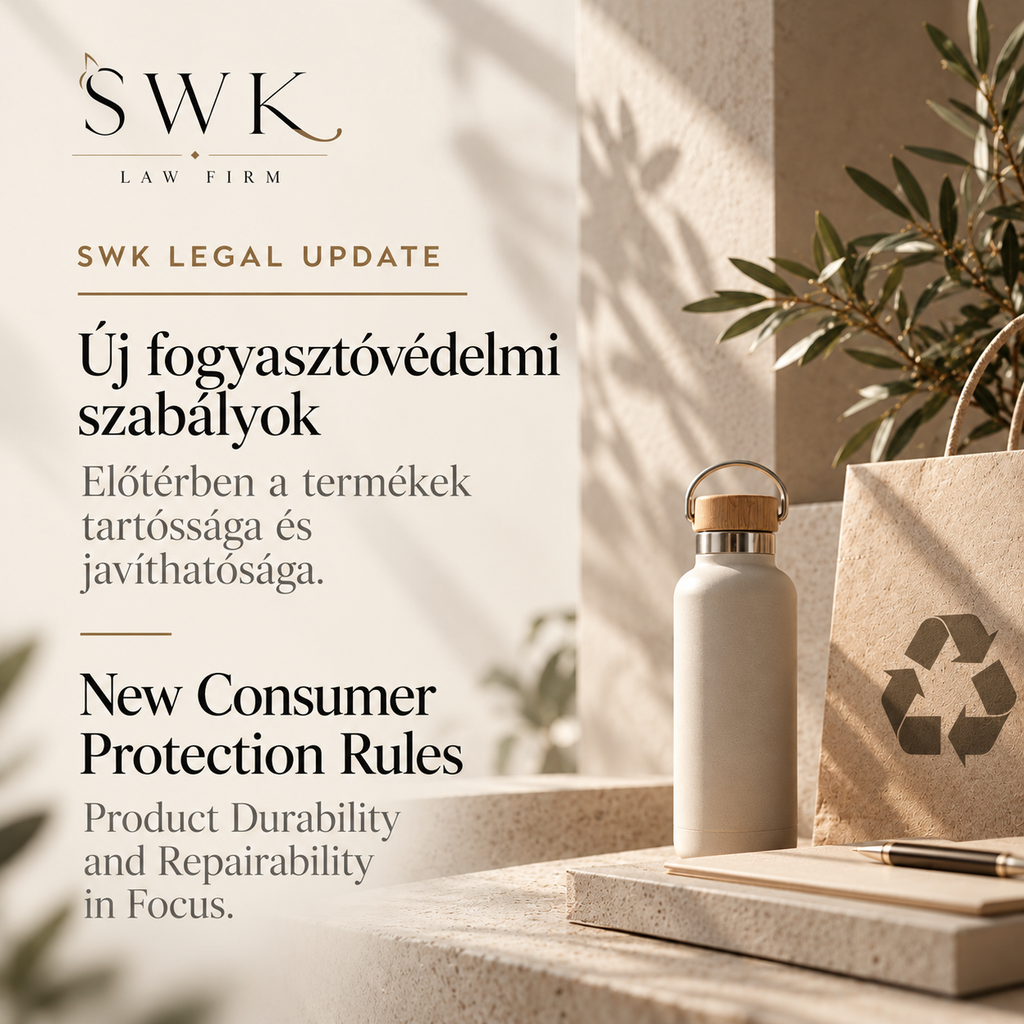
New consumer protection requirements have applied in Hungary since 27 September 2026, affecting environmental claims, information on product durability and repairability, and the use of sustainability labels. The changes are particularly relevant to manufacturers, distributors, retailers and businesses engaged in online sales.
The new regulatory framework is based on Directive (EU) 2024/825, which aims to strengthen consumer protection against misleading environmental claims and practices associated with the premature obsolescence of products.
Stricter Rules on Misleading Environmental Claims
Terms such as “eco-friendly”, “green”, “sustainable” and “climate-friendly” have become increasingly common in commercial communications.
Under the new rules, generic environmental claims may constitute a prohibited commercial practice where the business cannot demonstrate the recognised excellent environmental performance required to support them.
Businesses should therefore review whether their environmental claims are accurate, substantiated and unlikely to mislead consumers.
Product Durability and Repairability Under Greater Scrutiny
The changes extend beyond environmental marketing. They also introduce requirements concerning product lifespan, repairability and information provided to consumers.
For example, businesses must avoid unfounded claims about how long a product can be used under normal conditions or misleading statements about its repairability.
The objective is to enable consumers to make purchasing decisions based on reliable and meaningful information.
Sustainability Labels and Certification Schemes
The new framework also restricts the use of sustainability labels.
Businesses may not display sustainability labels that are neither based on a qualifying certification scheme nor established by public authorities.
This is particularly relevant to companies using their own environmental logos, sustainability badges or similar symbols on product packaging, websites and advertising materials.

What Should Businesses Review?
Compliance with the new requirements goes beyond reviewing contractual documentation and general terms and conditions.
Businesses should consider examining product labels, packaging claims, online product descriptions, advertising campaigns and sustainability communications.
It is also important to maintain appropriate evidence supporting commercial claims and to establish effective internal review procedures.
Consumer Protection as a Business Priority
Misleading commercial practices may result in regulatory investigations and sanctions, while also damaging consumer confidence and a company’s market reputation.
The requirements applicable from September 2026 therefore make a review of existing marketing and consumer information practices particularly important.
Accurate and properly substantiated commercial communication is not only a compliance obligation but also an essential foundation for long-term business trust.
SWK Law Firm – Business Mindset. Legal Precision.